| |
|
How to Get Raccoons out of the Ceiling
You may hear scratching or thumping or walking above your head, up in the ceiling of your house. Perhaps you even hear
some vocal chirps or growls. The noises can occur at any time, but they're more common at night. If it's springtime, then it's almost certainly raccoon in the ceiling.
Mother raccoons choose to live inside houses, because they are warm, safe, and dry. They often live in the attic, so you'll hear them walking on the ceiling, but they can
even live between floors, so you could hear them on the first floor ceiling as well. Here's how to get raccoons out of the ceiling:
Step 1: Properly identify the species of animal. Many animals live inside attics and ceilings, including squirrels, rats, opossums, and more. The type of animal will
determine the type of approach you'll take in solving the problem. Inspect the attic or ceiling space for footprints and scat (poop). Click here to see my photos of animal poop in attics.
You can also see the animal from time to time, crawling up and down your house. Or, you can listen to the noises in the attic, and determine what animal is making the noise.
Step 2: Find out how they are getting into the house. Do a full inspection of the house, and find the entry point. With raccoons, it's not very hard, because they need a big opening. They often tear open roof ducts,
or vents, or they rip the soffit out, or they can even break open a hole in the roof.
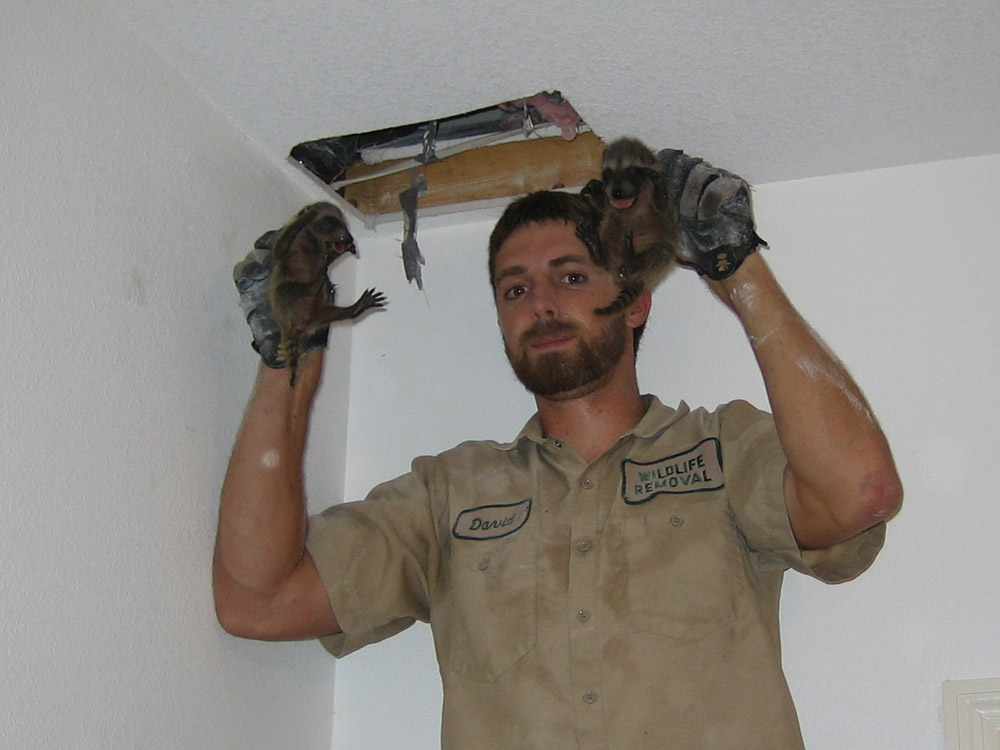
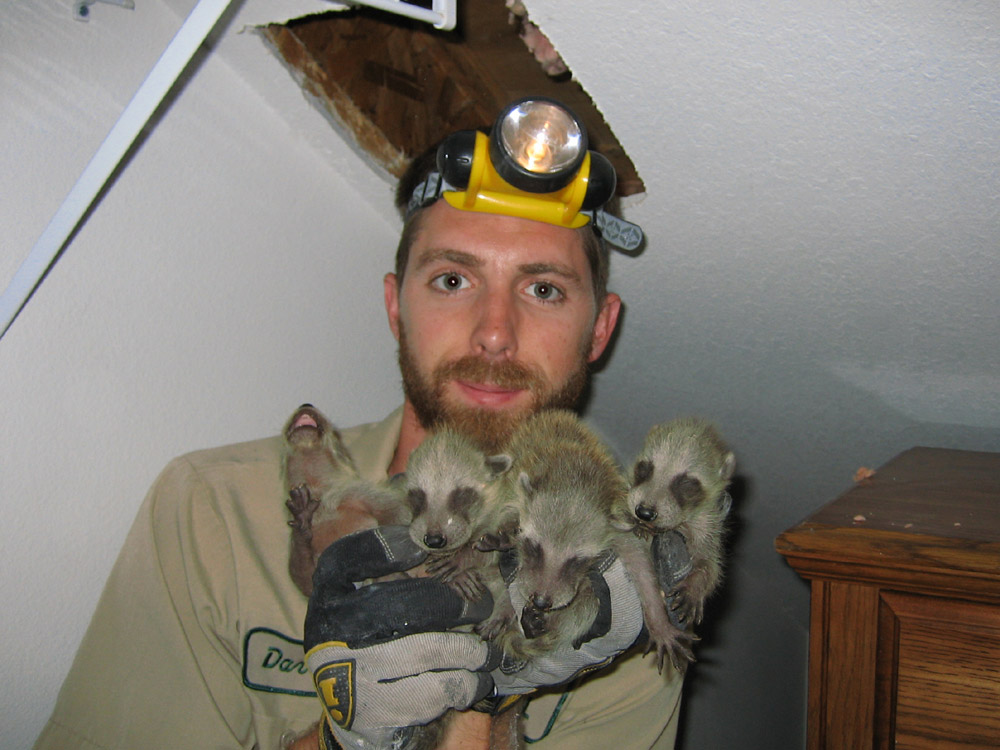
Step 3: THIS IS VERY IMPORTANT: DETERMINE IF THERE ARE BABY RACCOONS. If so, you need to remove them as well as the adult female raccoon! I usually remove the babies by hand, by crawling in the attic or cutting a hole
in the ceiling to remove them. If you fail at this, the babies will suffer and starve to death, and create a big noise for two weeks, and then die and rot and stink for many weeks.
Step 4: Trap and remove the adult raccoon(s). I often use the live baby raccoons as bait to lure in the mother. Sometimes special traps are mounted directly on the entry/exit hole. In some special cases, I am able
to enter the attic and snare the raccoon by hand, with a snare pole, no traps necessary. Successful trapping is difficult to do for amateurs.
Step 5: Fix the entry hole(s). Once the raccoons are out, repair the hole they used to get in, or you'll just get more raccoon problems in the future!
Step 6: Clean the area the raccoons were living in. To learn more about this process, click on: Attic Cleanup.
Step 7: Hire a pro. If you can't do it yourself, safely and legally (and it's illegal in most states to trap wildlife without a license), then you might want to consider hiring a professional, for both your own safety,
and for the safety of your home and property. I've seen too many do-it-yourself raccoon jobs gone horribly wrong, for both the people and the animals.
For a nationwide directory of over 600 trapping companies, click here: wildlife control directory.
|
Raccoons can cause significant damage in an attic, both by
contamination from their waste or by structural damage to insulation, beams, or even by chewing on wires. They will search hard for food, and are fond of tipping
over trash cans, raiding dumpsters, and stealing pet food. They will often break into a screened-in porch to
get pet food. If there's food or shelter to be had, raccoons will break into your house. At times, they'll crawl under houses and up the walls, and sometimes baby raccoons are in the walls.
They carry a number of parasites and diseases that can affect people or pets. They are the #1
carrier of rabies, a potentially fatal disease. They also carry canine distemper, which can kill
your dog. Their feces may contain raccoon roundworm, the spores of which humans can breath in and become
seriously infected by, so it is important to capture raccoons using human habitat. To see a picture of raccoons
captured using roof level trapping, click here. For more fine photos of baby raccoons with
mother, click here.
 |
 |
 |
 |
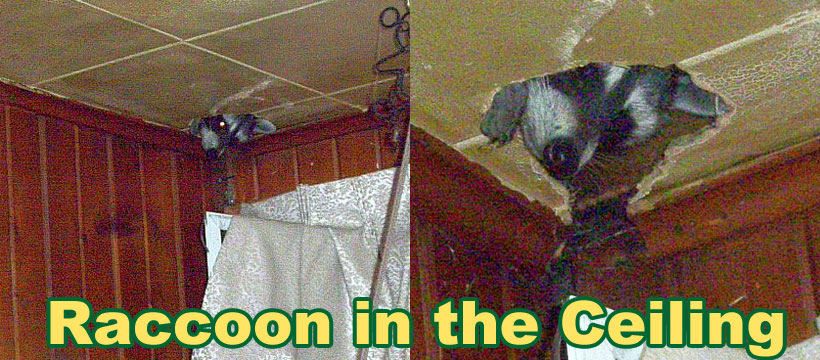
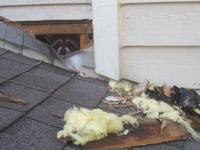
| A raccoon that tore a hole at the ceiling. |
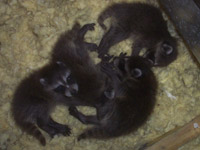
A raccoon nest in a ceiling. |
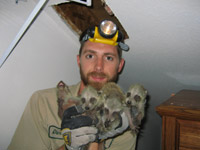
Baby raccoons I removed from a ceiling. |
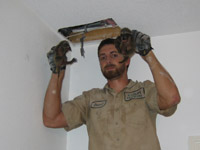
I cut a hole in this ceiling as well. |
Can raccoon in attic crash through ceiling - The average adult raccoon only weighs about twenty pounds, but some have known to weigh as much as forty. This means a raccoon could absolutely come through your ceiling, though it would require a bit of force from the other end. Most drywall and building material can support the weight of a 40-pound critter, but if that animal was romping around and took a tumble, the force could potentially send it through the ceiling. It’s a pretty unlikely scenario, but one you can’t rule out. Of course, even if the raccoon can’t come through the upper part of your home, you should still have the animal removed. Raccoons can cause a lot of damage to structure and electrical wires, not to mention they open your home up to more problematic animals like rats. You can have the pest removed by a professional, or at least by someone who has a license to perform the job. Because this isn’t a situation where you’re after the creature’s fur, there is no reason to lethally trap the raccoon. The expert can use a cage trap secured to the roof, the attic opening, or set solidly on the ground near a path of travel.
24/7 Wildlife Removal operates in the Greater Orlando area of central Florida. This is a specialty wildlife removal business. Wild animal control is all I do - I
do not spray poison for insect control. I provide raccoon trapping and removal for raccoon control. I do not run an exterminating business or a pest control
business, I run a nuisance wildlife business. I do not provide extermination of raccoons, but humane trapping and relocation. If you want to get rid of your raccoon
problem or get rid of raccoons in the attic once and for all, give me a call!
| |
|